
The AI Adoption Hub
A growing library of answers, guides, and practical resources for modern businesses.
LearnAI explained, without the noise. Clear answers, practical examples, and continuously updated resources designed to help growing businesses understand, adopt, and scale AI with confidence.
-
Plain explanation: AI means teaching computers to perform tasks that usually require human thinking — like recognizing a face, understanding speech, or recommending a movie. Think of it as a very fast, very focused assistant built from software and lots of data.
Everyday examples: Smart phone voice assistants (listening and answering), automatic photo sorting (grouping family photos), spam filters (keeping junk email out), and personalized recommendations on shopping or streaming sites.
Why it matters: AI can make everyday tasks easier, help businesses work faster, and assist doctors, teachers, and others to make better decisions. It can also create new kinds of jobs and services.
Reassurance: AI is a tool created and set up by people. It’s not magic or a human mind — its usefulness depends on the data and instructions people give it.
-
Conceptual framing: AI here refers to systems that ingest, learn from, and make predictions or decisions based on large volumes of structured and unstructured data. Common enterprise AI uses include automation of workflows, predictive analytics, natural language processing (NLP) for customer interactions, and generative models for content and code.
Key components covered: data pipelines and governance, model training and validation, feature engineering, model deployment and monitoring, MLOps practices, model explainability, and risk management (bias, fairness, privacy, regulatory compliance).
Practical guidance: decision criteria for model selection, evaluation metrics (precision/recall, AUC, calibration), strategies for productionalizing models, continuous retraining, drift detection, and logging/observability best practices.
Security and governance: approaches to data access controls, model auditing, lineage tracking, and compliance with industry standards and regulations. Notes on vendor selection, third-party model risk, and contract considerations.
Enterprise-ready examples: personalized customer experiences at scale, predictive maintenance for industrial equipment, fraud detection in finance, automated document understanding, and large-scale knowledge management using retrieval-augmented generation.
-
Short, nontechnical overviews for beginners that use everyday analogies and clear examples.
A practical glossary of common AI terms (model, algorithm, training, inference, dataset, supervised/unsupervised learning, neural network, deep learning, generative AI, LLM, fine-tuning, MLOps, explainability, bias, drift).
Scenario-driven explainers tailored to different audiences—consumers, managers, technical leads, and executives—showing use cases, risks, and how to evaluate solutions.
Checklists and templates for adoption: questions to ask vendors, basic data readiness checklist, governance checklist, and an initial risk-assessment template.
Visuals and step-by-step walkthroughs that map the lifecycle from data collection through model deployment and monitoring.
-
Clear, professional, and practical. We avoid unnecessary hype and focus on useful knowledge you can apply immediately.
Inclusive: content written so anyone can get started and so technical readers can drill into operational and governance details.
-
Start with the beginner overviews to build a common vocabulary.
Use the glossary to decode unfamiliar terms.
If you’re evaluating or running AI in an organization, go to the enterprise guides for checklists, metrics, and operational best practices.
Return to scenario explainers for real-world decision support and to communicate AI concepts clearly to nontechnical stakeholders.
-
Complete beginners of any age who want a clear introduction.
Managers and leaders who need to make informed decisions about AI adoption.
Technical professionals and architects who require operational guidance and best practices for enterprise implementation.
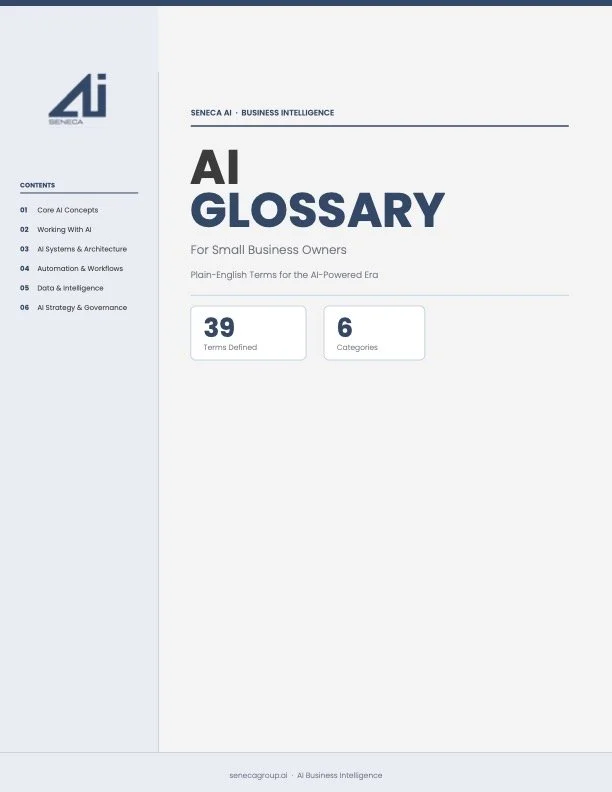
Click to download PDF